
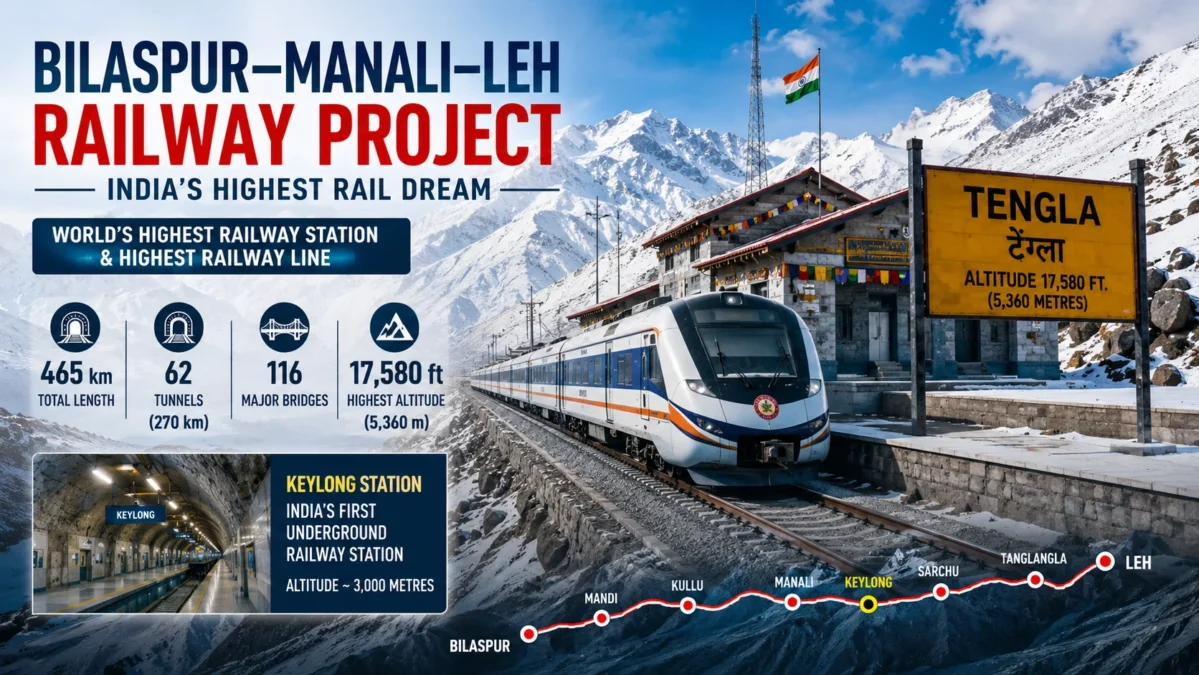
India is moving ahead with one of its most ambitious mountain infrastructure projects — the Bilaspur–Manali–Leh railway line, a strategic and engineering marvel that aims to connect the plains of Himachal Pradesh with the cold desert region of Ladakh.
The Bhanupali–Leh line (also referred to as the Bilaspur–Manali–Leh line) is a high-altitude, strategic railway project currently under construction in India.
The proposed railway will not only transform connectivity to Ladakh but is also expected to create several world records, including the world’s highest railway station and the highest railway track ever built.
This will reduce travel time from New Delhi to Leh to 10 hours, which takes 25–40 hours by road.
A Railway Above the Clouds
The Bilaspur–Manali–Leh railway project is planned to stretch approximately 465 kilometres from Bilaspur in Himachal Pradesh to Leh in Ladakh. The route passes through some of the toughest Himalayan terrain, crossing snowbound mountain passes, glacial valleys, and high-altitude deserts.
At its highest point, the railway is expected to reach around 17,580 feet (5,360 metres) above sea level near the planned Tengla station in Ladakh. Once completed, this would make it the highest railway station in the world.
The railway line itself will also surpass the famous Qinghai–Tibet Railway in China, becoming the highest railway track globally.
Key Highlights of the Project
| Feature | Details |
|---|---|
| Project Name | Bilaspur–Manali–Leh Railway |
| Total Length | Around 465 km |
| Highest Altitude | Approximately 17,580 ft (5,360 m) |
| Proposed Highest Station | Tengla Station |
| Total Tunnels | 62 |
| Tunnel Length | Around 270 km |
| Major Bridges | 116 |
| Underground Station | Keylong Station |
| States/Regions Connected | Himachal Pradesh and Ladakh |
Tengla Station: The World’s Highest Railway Station
A major highlight of the project is the proposed Tengla railway station in Ladakh. Situated at an extreme altitude of around 5,360 metres, the station is expected to break global records.
World’s highest railway: The station at Tengla (near Taglang La) is projected to be the highest in the world at an altitude of approximately 5,359 metres (17,582 ft), surpassing the current record held by the Tanggula railway station in Tibet.
Operating a railway station at such a height presents enormous challenges. Engineers will need to deal with:
- Low oxygen levels
- Extreme winter temperatures
- Heavy snowfall
- Permafrost and unstable mountain geology
- High seismic activity
Despite these challenges, the project is seen as a major technological achievement for Indian Railways.
Keylong Station: India’s First Underground Mountain Station
Another unique feature of the project is the construction of Keylong station entirely inside a tunnel. Located at an altitude of around 3,000 metres in Himachal Pradesh, this station will become India’s first underground railway station built within a mountain tunnel.
The underground design helps protect the station from:
- Snow avalanches
- Harsh winter weather
- Landslides
- Extreme temperature variations
This approach is expected to improve year-round railway operations in the Himalayan region.
Engineering Challenges in the Himalayas
The Bilaspur–Manali–Leh line is considered one of the toughest railway projects ever attempted in India.
The route requires:
- 62 tunnels covering approximately 270 km
- 116 major bridges across deep valleys and rivers
- Construction in remote, high-altitude terrain
- Specialized technology for cold-weather railway systems
Large sections of the line will pass through geologically fragile regions where temperatures can drop far below freezing during winter.
Strategic Importance of the Railway
Apart from tourism and economic benefits, the railway line has major strategic significance for India.
Currently, Ladakh remains heavily dependent on highways such as the Manali–Leh Highway and the Srinagar–Leh Highway, both of which remain closed for several months during winter due to snow.
The new railway line is expected to:
- Provide all-weather connectivity
- Improve transport for local residents
- Boost tourism in Ladakh
- Strengthen supply lines to border regions
- Support economic growth and regional development
Tourism Impact on Ladakh
Once operational, the railway could completely transform tourism in Ladakh. Travelers may eventually be able to journey by train through some of the most dramatic Himalayan landscapes in the world.
The project could open up easier access to destinations such as:
- Leh
- Keylong
- Sarchu
- Pang region
- High mountain passes of the Himalayas
For adventure travelers and railway enthusiasts, the Bilaspur–Manali–Leh route may become one of the world’s most iconic train journeys.
The Future of Himalayan Rail Connectivity
The Bilaspur–Manali–Leh railway represents a major step in India’s push toward high-altitude infrastructure development. Combining strategic planning, advanced engineering, and mountain railway innovation, the project is expected to redefine rail travel in the Himalayas.
If completed as planned, it will stand among the most extraordinary railway engineering achievements anywhere in the world. – Source – Wikipedia